
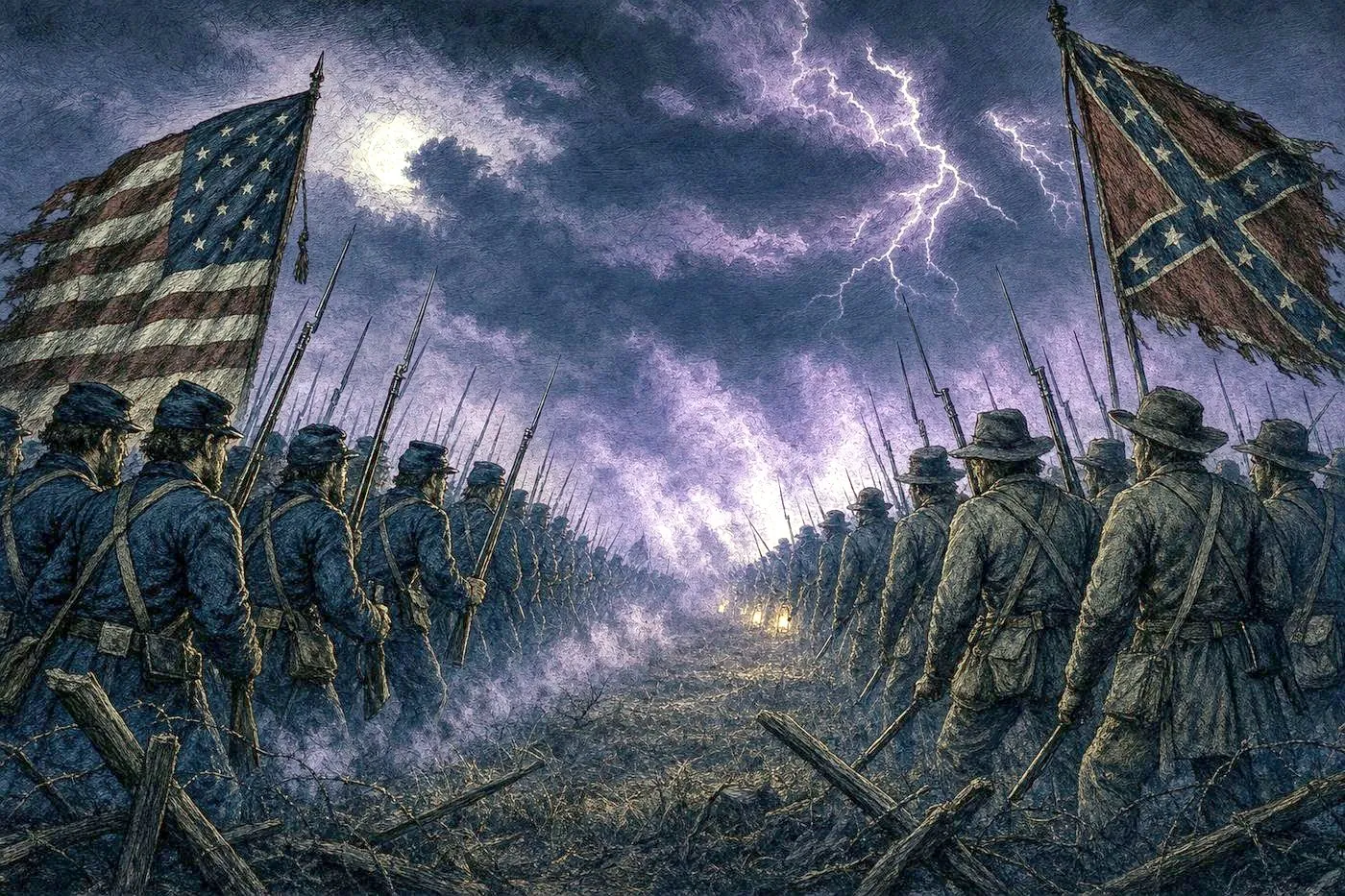
A Nation Divided over Slavery
By the middle of the nineteenth century, the United States was split between a South whose economy and social order depended on enslaved labour, and a North where slavery had been abolished and free-labour industry was expanding. For decades, Congress had tried to manage the resulting tensions through compromise, admitting new states in pairs to preserve a balance between free and slave states and negotiating over whether slavery could extend into western territories. Each compromise proved temporary. The Kansas-Nebraska Act of 1854 and the violence that followed in Kansas, the Supreme Court’s 1857 Dred Scott decision denying citizenship to Black Americans, and the growing strength of the antislavery Republican Party all deepened the divide. Slavery, not abstract disagreements over states’ rights or tariffs, was the central and repeatedly stated cause of the sectional crisis: secession declarations issued by Southern states in 1860 and 1861 explicitly cited the protection of slavery as their reason for leaving the Union.
Abraham Lincoln’s election in November 1860, on a platform that opposed slavery’s expansion into new territories without calling for its immediate abolition where it already existed, was enough to convince many Southern leaders that the institution’s long-term future was at risk. South Carolina seceded first, in December 1860, and by February 1861 six more Deep South states had joined it to form the Confederate States of America, with Jefferson Davis as president. Four more states, including Virginia, seceded after fighting began. Lincoln and the remaining Union states refused to recognise the legitimacy of secession.
From Fort Sumter to Gettysburg
The war began on 12 April 1861, when Confederate artillery opened fire on the Union-held Fort Sumter in Charleston Harbor, forcing its surrender within two days. Both sides expected a short conflict; instead the war lasted four years and became the deadliest in American history, with deaths from combat and disease commonly estimated in the range of 620,000 to 750,000. Early fighting ranged across a wide theatre, from Virginia in the east to the Mississippi Valley in the west, with neither side gaining a decisive advantage through 1862.
The war’s character shifted with the Emancipation Proclamation, which Lincoln issued on 1 January 1863. It declared enslaved people free in Confederate-held territory, did not apply to slave states that had remained in the Union, and rested on Lincoln’s war powers rather than an act of Congress. But it transformed the Union’s cause into an explicit fight against slavery and opened Union military service to Black soldiers, tens of thousands of whom went on to serve. Later that same year, in July 1863, Union forces under George Meade repelled General Robert E. Lee’s invasion of the North at the Battle of Gettysburg in Pennsylvania, inflicting heavy losses on the Confederate army in the largest battle of the war. Lincoln’s brief address at the dedication of the Gettysburg battlefield cemetery that November gave the war a lasting statement of purpose, closing with the hope that “government of the people, by the people, for the people, shall not perish from the earth.”
Union Victory and Its Aftermath

Gettysburg, together with the Union’s capture of Vicksburg on the Mississippi River that same week, marked a turning point, though nearly two more years of grinding warfare followed. Union General Ulysses S. Grant pursued a strategy of sustained pressure against Lee’s army in Virginia, while General William Tecumseh Sherman’s campaigns through Georgia and the Carolinas struck at the Confederacy’s ability to sustain the war. By early 1865, Confederate forces and resources were exhausted. On 9 April 1865, Lee surrendered the Army of Northern Virginia to Grant at Appomattox Court House, and other Confederate armies surrendered in the weeks that followed, bringing the war to an end. Lincoln was assassinated by John Wilkes Booth less than a week later, on 14–15 April 1865, and did not live to oversee the peace.
The war preserved the Union and ended slavery in the United States, formalised by the Thirteenth Amendment’s ratification in December 1865. The Reconstruction era that followed sought to rebuild the South and secure citizenship and voting rights for formerly enslaved people through the Fourteenth and Fifteenth Amendments, though these gains were unevenly enforced and were rolled back across much of the South in the decades afterward. The war’s scale of loss, and the constitutional questions it settled about the Union’s permanence and slavery’s illegality, mark it as the defining conflict of nineteenth-century American history.