
This timeline of World War I traces the conflict from the 1914 assassination that triggered it through the 1918 armistice and 1919 peace settlement, with dates drawn from standard historical reference sources.
Origins and Outbreak, 1914
The immediate spark for the First World War was the assassination of Archduke Franz Ferdinand, heir to the Austro-Hungarian throne, by a Bosnian Serb nationalist in Sarajevo on June 28, 1914. What followed was a month-long diplomatic crisis in which Austria-Hungary, backed by Germany, issued an ultimatum to Serbia. A network of alliances and mobilization plans then converted a regional dispute into a general European war within weeks: Russia mobilized in support of Serbia, Germany declared war on Russia and France, and Germany’s invasion of neutral Belgium brought Britain into the conflict by early August 1914. German strategy, built around the long-planned Schlieffen concept of a rapid knockout blow against France, stalled by early autumn, and the war on the Western Front settled into the trench lines that would define it for the next four years. The conflict was never confined to Europe: the Ottoman Empire entered the war on the side of Germany and Austria-Hungary later in 1914, opening fronts in the Middle East and the Caucasus, and colonial troops and resources from across the British, French, and other empires were drawn into the fighting from the outset, making it a genuinely global war rather than a purely European one.
Stalemate and Attrition, 1915–1917
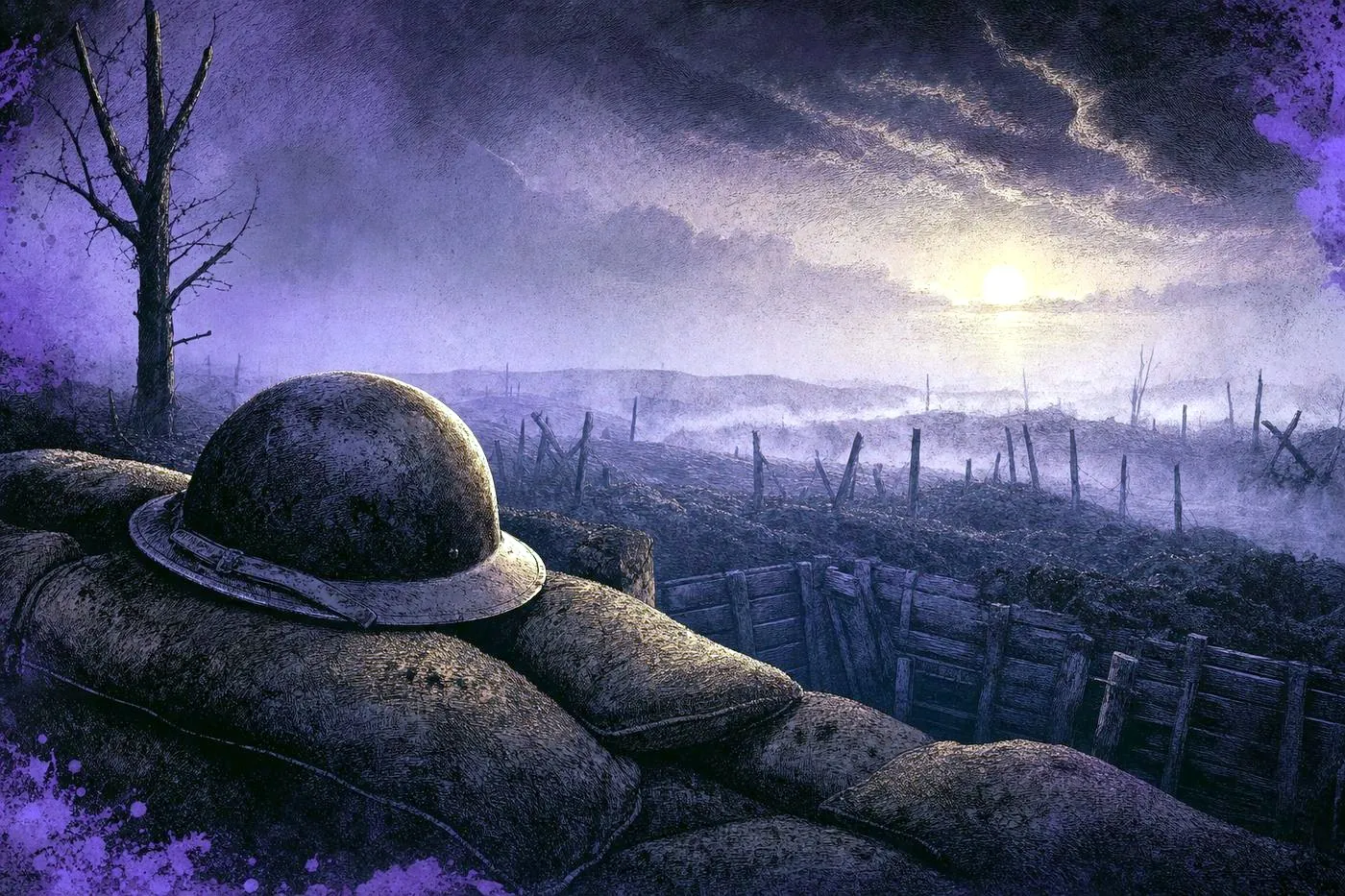
By 1915, both sides faced a static front protected by trenches, barbed wire, and machine guns, and commanders on both sides searched for ways to break the deadlock. German forces used chlorine gas against Allied lines at the Second Battle of Ypres, opening a new and widely condemned dimension of industrialized warfare, while an Allied attempt to open a new front by forcing the Dardanelles Strait ended in a costly withdrawal from Gallipoli. The years 1916 and 1917 brought some of the war’s most devastating engagements: the Battle of Verdun, fought almost entirely for symbolic and attritional reasons, and the Battle of the Somme, in which the British army suffered roughly 57,000 casualties on the first day alone, among the worst single-day losses in its history. Casualty figures from this period are commonly cited in wide ranges by historians and should be treated as estimates rather than precise counts, but the scale of loss on all sides was unprecedented in European warfare. Life in the trenches themselves became a defining image of the war: soldiers endured mud, disease, rats, and near-constant artillery bombardment in fixed lines that, on the Western Front, moved only a few miles in either direction across several years of fighting, even as new technologies such as tanks, aircraft, and improved artillery tactics were introduced in an effort to restore mobility to the battlefield.
American Entry, Collapse, and Armistice, 1917–1919
The war’s balance shifted in 1917. Unrestricted German submarine warfare against shipping, including neutral vessels, helped bring the United States into the war in April 1917, adding fresh manpower and industrial capacity to the Allied side. That same year, mounting war-weariness and political upheaval inside Russia culminated in the Russian Revolution, and the new Bolshevik government negotiated an exit from the war, formalized in the Treaty of Brest-Litovsk in March 1918. Germany’s last major offensive on the Western Front in spring 1918 failed to achieve a decisive breakthrough, and a series of Allied counter-offensives through the summer and autumn pushed German forces into a steady retreat. Facing military collapse, revolution at home, and the abdication of Kaiser Wilhelm II, Germany agreed to an armistice that took effect at 11 a.m. on November 11, 1918. The formal peace was concluded the following year with the Treaty of Versailles, signed in June 1919, which assigned Germany responsibility for the war, imposed reparations, and redrew borders across Central and Eastern Europe, terms whose long-term consequences historians continue to debate. Beyond Versailles, a wider series of treaties dissolved the Austro-Hungarian and Ottoman empires and created new states across Central Europe and the Middle East, while the war’s total death toll, combining military and civilian losses across all combatant nations, is generally estimated in the range of 15 to 20 million, alongside millions more wounded, figures that historians continue to refine and that vary depending on which related causes of death, such as the 1918 influenza pandemic, are included.