
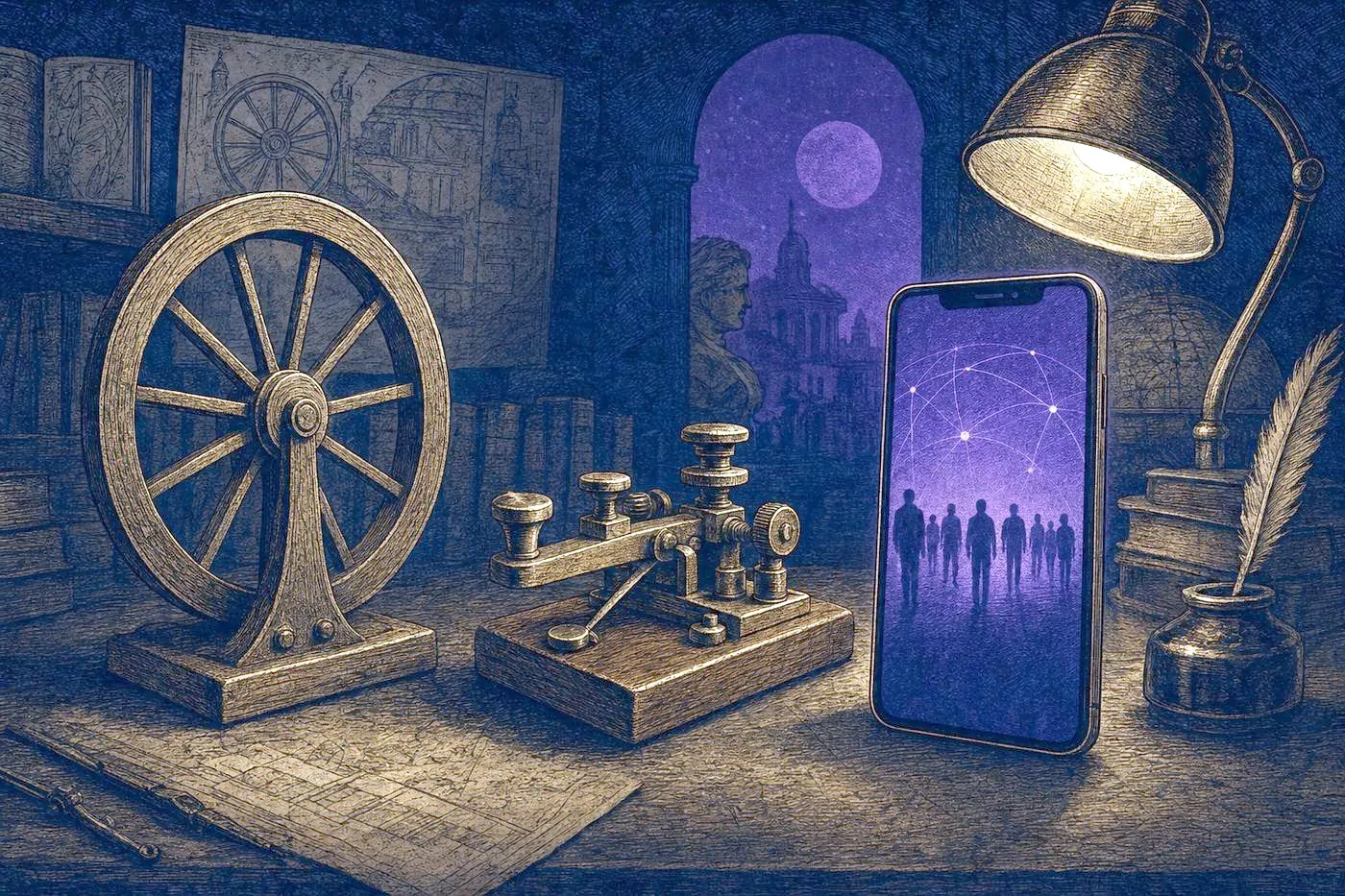
This technology timeline surveys some of the milestones that most broadly changed how people move, build, and communicate, deliberately ranging across ancient, industrial, and digital-era inventions rather than focusing on any single field.
Ancient and Early Mechanical Breakthroughs
Long before any written record, the wheel emerged as one of the most consequential technologies in human history. Archaeological evidence places its earliest known use in Mesopotamia around 3500 BCE, and most historians believe it was first developed for pottery wheels before being adapted for carts and transport, a reminder that many transformative technologies begin with a narrower purpose than the one that makes them famous. Thousands of years later, in the German city of Mainz around 1440, Johannes Gutenberg developed a printing press using movable metal type. Gutenberg’s press made it dramatically cheaper and faster to reproduce text than hand-copying manuscripts, and its spread across Europe over the following decades is widely credited with accelerating literacy, scholarship, and the circulation of ideas that helped fuel the Renaissance and Reformation. Within roughly fifty years of Gutenberg’s invention, printing presses had been established in cities across the continent, and the total number of books in circulation is estimated to have grown from a small, closely guarded body of manuscripts into millions of printed copies, an early demonstration of how a single mechanical invention could reshape the spread of knowledge itself.
The Industrial and Mechanical Age
The nineteenth century compressed centuries of change into a few decades. Long-distance communication was transformed by the electric telegraph: William Cooke and Charles Wheatstone patented a working telegraph system in Britain in 1837, and in the United States, Samuel Morse demonstrated a long-distance telegraph line in 1844, sending messages that had previously taken days or weeks in a matter of minutes. Personal transport underwent a similar leap later in the century when German engineer Karl Benz patented his three-wheeled Patent-Motorwagen in 1886, an internal-combustion vehicle generally regarded as the first true automobile, even though other inventors were experimenting with motorized vehicles around the same period; within a few decades, mass-production techniques pioneered by manufacturers such as Henry Ford would turn the automobile from a novelty into an everyday household purchase. Then, on December 17, 1903, at Kitty Hawk, North Carolina, brothers Orville and Wilbur Wright achieved the first controlled and sustained flight of a powered aircraft: a feat that, within little more than half a century, led to routine commercial air travel across continents and oceans.

Into the Digital and Mobile Era
The twentieth and twenty-first centuries brought a further acceleration, as electronics and computing reshaped nearly every other technology on this list. Rather than retracing the history of the computer or television in detail (subjects covered elsewhere on this site), this timeline closes with a milestone that reflects how thoroughly technology had become mobile and personal by the early 2000s: the 2007 launch of Apple’s iPhone. By combining a touchscreen, internet connectivity, and computing power into a single handheld device, the iPhone helped popularize the modern smartphone, and within roughly a decade, similar devices became the primary computer for a large share of the world’s population, combining functions once split across separate cameras, music players, and desktop computers into one pocket-sized object. Seen together, these milestones span the wheel, the printing press, the telegraph, the automobile, powered flight, and the smartphone. They trace a broader pattern in the history of technology: each new tool did not just solve an old problem, but expanded what people could reasonably expect to do next, from moving goods across a room to carrying a global information network in a pocket.