From Mechanical Calculation to the First Electronic Computers
Before anything resembling a modern computer existed, calculation was a mechanical and electromechanical affair. During the Second World War, British codebreakers at Bletchley Park built Colossus, a machine using vacuum tubes to help decrypt German military communications; because the project remained classified for decades, its influence on later computing was recognised only long after the fact. In the United States, Harvard’s Mark I, completed in 1944 with backing from IBM, used electromechanical relays and switches to carry out long sequences of arithmetic automatically, though it was slow and noisy by later standards.
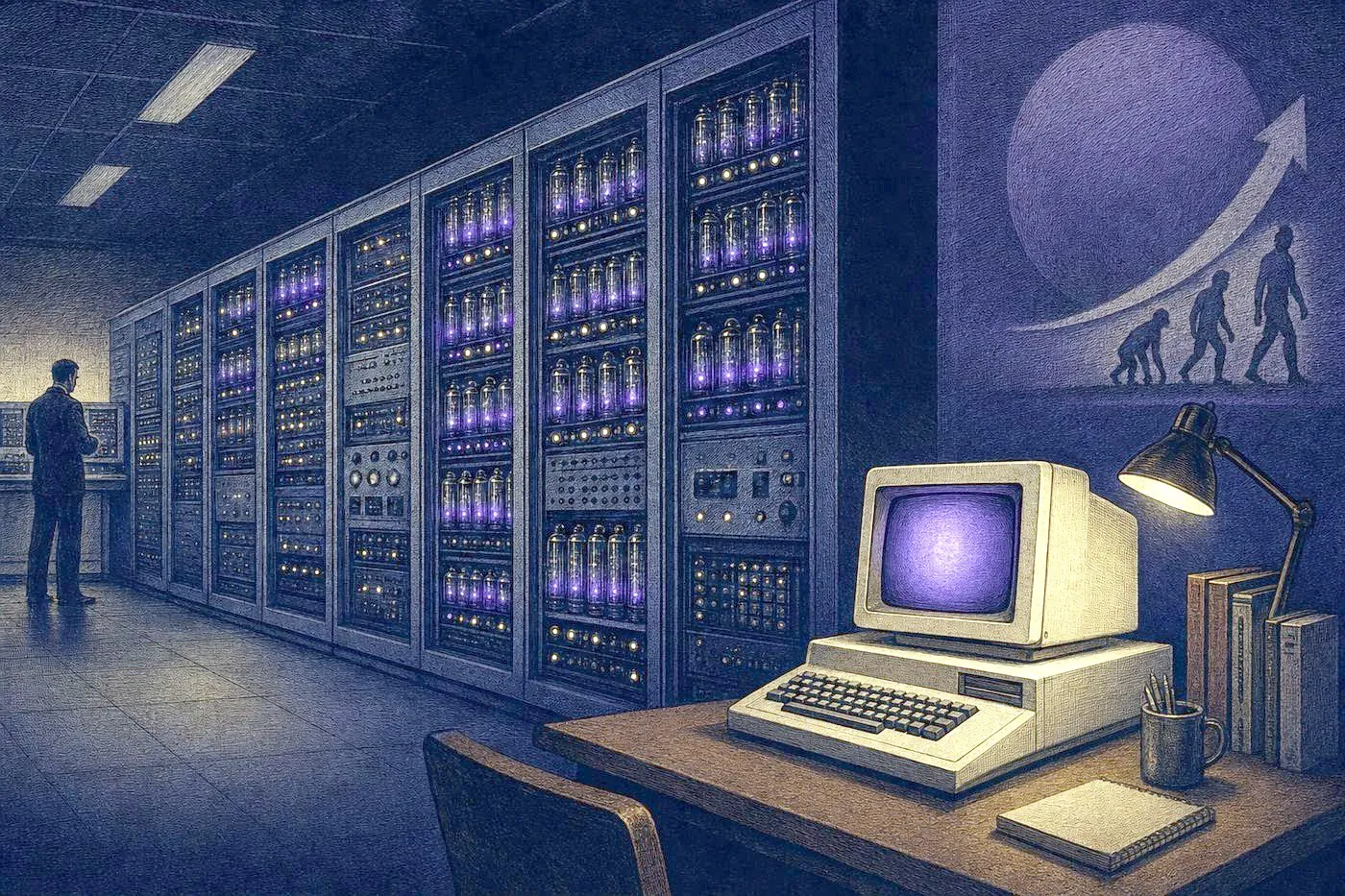
The clearer turning point came with ENIAC, completed in 1945 at the University of Pennsylvania and unveiled publicly the following year. Built for the US Army to calculate artillery firing tables, ENIAC used roughly 18,000 vacuum tubes and filled a large room, but it could perform calculations thousands of times faster than any electromechanical predecessor. It was not a stored-program computer in the modern sense: reprogramming it meant physically rewiring plugboards and switches. But it demonstrated that fully electronic computation was practical, and it set the stage for the stored-program machines that followed later in the decade.
The Transistor and the Integrated Circuit
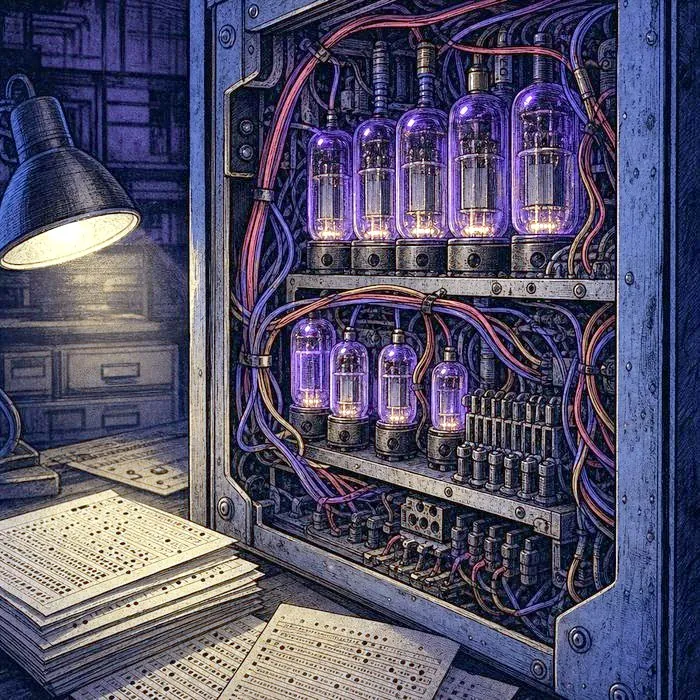
Vacuum tubes were fragile, power-hungry, and prone to burning out, which limited how large and reliable a computer could be. That constraint eased in 1947, when John Bardeen, Walter Brattain, and William Shockley at Bell Labs invented the transistor, a solid-state device that could switch and amplify electrical signals while using far less power and generating far less heat than a tube. Transistors gradually replaced tubes through the 1950s, shrinking computers and making them more dependable.
The next major leap came at the end of that decade. In 1958, Jack Kilby at Texas Instruments built the first working integrated circuit, demonstrating that multiple transistors and other components could be fabricated together on a single piece of semiconductor material. Robert Noyce at Fairchild Semiconductor independently developed a more practical version soon after, and the integrated circuit became the foundation of the semiconductor industry. Through the 1960s, integrated circuits allowed companies like IBM to build mainframe computers for businesses and governments, while smaller “minicomputers” from firms such as Digital Equipment Corporation brought computing within reach of university departments and research labs that could never have afforded a mainframe.
The Microprocessor and the Rise of the Personal Computer
Miniaturisation reached a new threshold in 1971, when Intel released the 4004, a chip that placed an entire central processing unit onto a single piece of silicon. The microprocessor made it possible, for the first time, to imagine a computer small and cheap enough for an individual rather than an institution to own.
That possibility became real in 1975 with the Altair 8800, a mail-order kit from a small Albuquerque company called MITS. It had no keyboard, screen, or permanent storage; results were read from a panel of blinking lights. Yet it galvanised a community of hobbyists and is often credited as the spark that launched the personal computer industry; it was also the machine for which a young Bill Gates and Paul Allen wrote software, leading to the founding of Microsoft. Companies moved quickly to build on that momentum: Apple, founded in 1976, released the Apple II in 1977 as a fully assembled machine with a keyboard, color graphics, and expansion slots, aimed at homes, schools, and small businesses rather than electronics enthusiasts.
The final piece of legitimacy arrived in 1981, when IBM, then the dominant name in business computing, launched the IBM PC. Its relatively open architecture allowed other manufacturers to build compatible machines, and that openness, reinforced through the 1980s by the spread of MS-DOS and later Microsoft Windows, turned the personal computer from a hobbyist curiosity into the standard tool of offices, schools, and homes by the end of the century.