
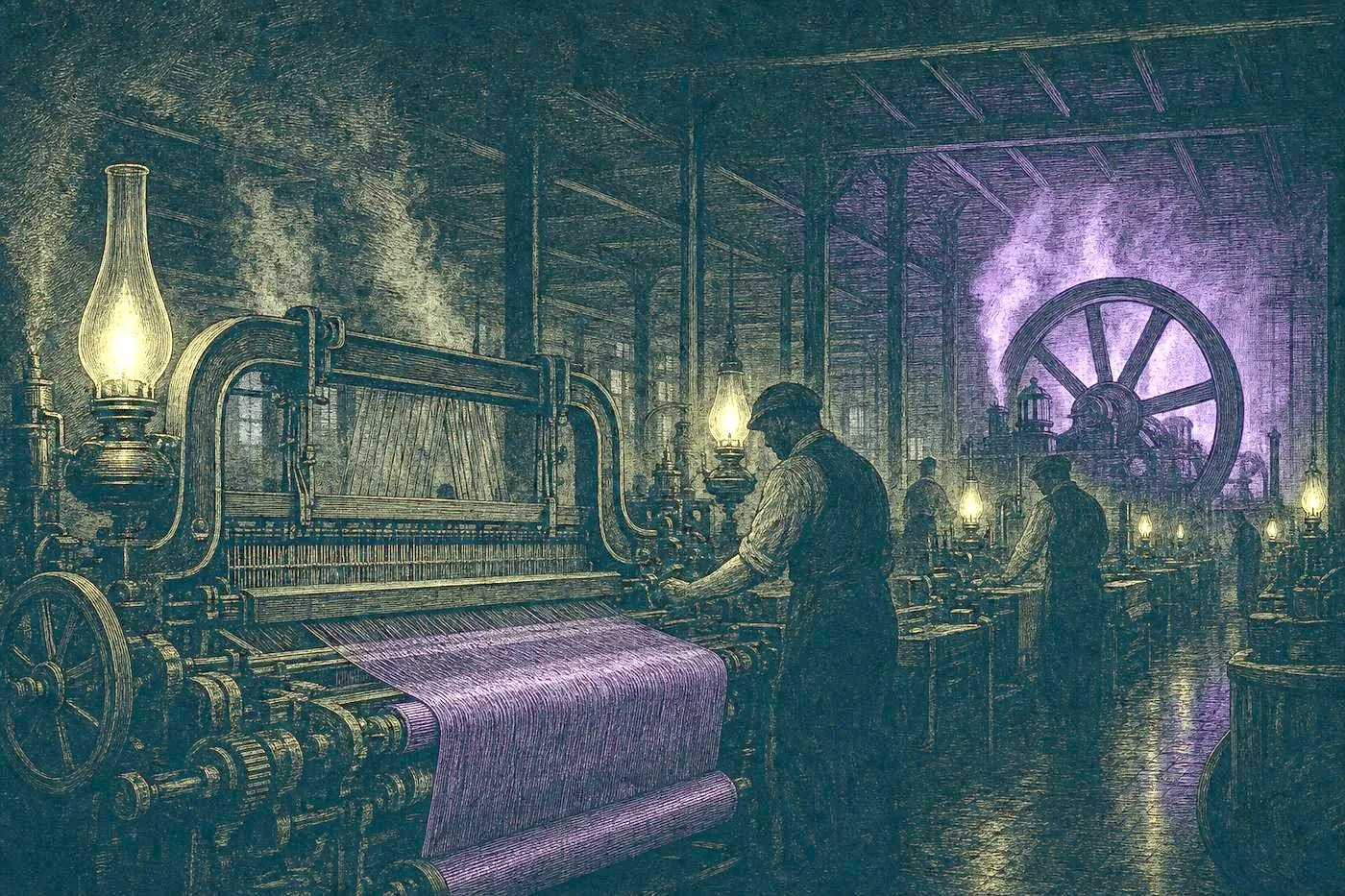
This industrial revolution timeline of events traces the transformation of Britain, Europe, and the United States from agrarian and handcraft economies into industrial, factory-based societies, sourced and dated so it can be cited with confidence. It follows the industrial revolution timeline from its roots in eighteenth-century textile mills and steam power through the railway age and into the electrified, steel-driven Second Industrial Revolution of the late nineteenth century.
The Industrial Revolution Timeline: Origins in Britain
The industrial revolution timeline begins in Britain in the 1760s and 1770s, as a handful of mechanical inventions turned small-scale textile production into a factory-based industry. James Hargreaves’s spinning jenny (1764) and Richard Arkwright’s water frame (1769) mechanized spinning, while James Watt’s improved steam engine, patented in 1769 and further refined through the 1770s and 1780s, gave manufacturers a power source that did not depend on a river or a water wheel. Edmund Cartwright’s power loom, patented in 1785, mechanized weaving in turn and accelerated the growth of large cotton mills across Lancashire and beyond. These early decades set the pattern for everything that followed on the industrial revolution timeline: mechanized production, concentrated in factories, replacing work that had previously been done by hand in homes and small workshops.
“A power source that did not depend on a river or a water wheel turned out to be exactly what factory production had been missing.”
Industrial Revolution Timeline of Events, Decade by Decade
Read as an industrial revolution timeline of events, the early 1800s mark the shift from mechanized textiles to mechanized transport. Richard Trevithick built the first practical steam locomotive in 1804, and George Stephenson’s Rocket, in 1829, proved that steam-powered rail travel could be fast, reliable, and commercially viable. The 1830s and 1840s brought a railway boom that transformed transport and industry across Britain before spreading to continental Europe and the United States, and the factory system that had started in textiles spread into iron, coal, and engineering. Viewed as an industrial revolution events timeline rather than a single invention story, this period is really about infrastructure: railways, canals, and steam-powered factories that let goods, workers, and raw materials move faster and further than before. By the mid-nineteenth century, this industrial revolution events timeline extends well beyond Britain, as industrialization takes hold in Belgium, France, the German states, and the northeastern United States.
Spread Across Europe and the Social History of Industrialization
By the 1870s, a Second Industrial Revolution was underway, built on steel production, electricity, and new chemical industries, and by the century’s end industrialization had reshaped economies across Europe and North America. This later history is inseparable from the human cost of the earlier factory system: rapid urbanization drew workers from the countryside into crowded industrial towns, child labor was common in mills and mines, and factory conditions were frequently harsh and dangerous. That record eventually produced a reform movement and a legal response: in Britain, a series of Factory Acts through the nineteenth century gradually restricted child labor and regulated working hours, and the same period saw the rise of trade unions and organized labor movements pushing for better conditions. Read in full, the industrial revolution timeline is as much a history of social change and reform as it is a history of machinery and output.
Frequently Asked Questions
What does this industrial revolution timeline cover?
This industrial revolution timeline of events covers the mechanization of textiles and steam power in 1760s–1780s Britain, the rise of steam-powered transport and the railway boom in the early-to-mid 1800s, the spread of industrialization to continental Europe and the United States, and the Second Industrial Revolution of the late nineteenth century.
When did the Industrial Revolution begin?
Most historians date the start of the Industrial Revolution to Britain in the 1760s, with early mechanized textile production and James Watt's improved steam engine, patented in 1769.
What is the difference between the First and Second Industrial Revolution?
The First Industrial Revolution (roughly 1760s–1830s) centered on textiles, steam power, and early railways in Britain, while the Second Industrial Revolution, beginning around the 1870s, was driven by steel, electricity, and chemical industries and spread more broadly across Europe and the United States.
What were the social effects of the Industrial Revolution?
Industrialization brought rapid urbanization, widespread child labor, and often harsh factory conditions, which in turn triggered reform legislation such as Britain's Factory Acts and the growth of organized labor movements, a part of the industrial revolution events timeline that is as important as the machinery itself.