
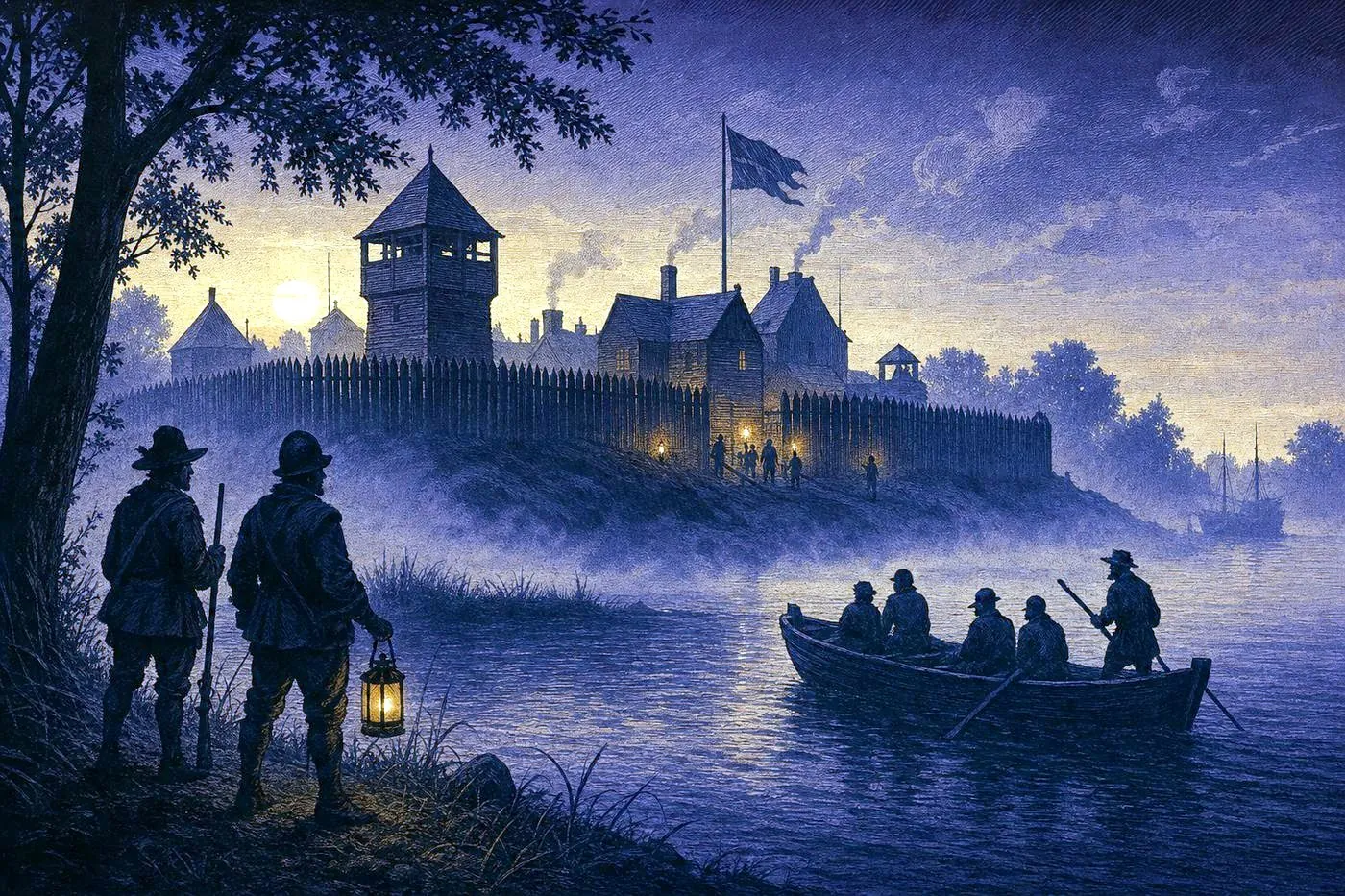
This Virginia history timeline of events traces the state’s development from the Powhatan Confederacy through Jamestown, the first permanent English colony in America, to its role in the founding of the nation and the Civil War, sourced and dated so it can be cited with confidence.
The Powhatan Confederacy and the Founding of Jamestown
Before English colonists arrived, the Tidewater region of Virginia was home to a sophisticated political network of dozens of Algonquian-speaking communities, unified under the paramount chief Powhatan (Wahunsenacawh) into a confederacy known as Tsenacommacah. In May 1607, colonists dispatched by the Virginia Company of London established a settlement they named Jamestown on a marshy peninsula along the James River, the first permanent English settlement in what would become the United States. The colony’s early years were marked by extraordinary hardship, including the winter of 1609–10, remembered as the “starving time,” during which disease, famine, and conflict with neighboring Powhatan communities killed the large majority of colonists. Relations between the English and the Powhatan alternated between trade, uneasy alliance (notably through the marriage of colonist John Rolfe and Pocahontas, daughter of Powhatan), and open warfare across the following decades. Jamestown nonetheless survived, in large part because Rolfe’s cultivation of a marketable strain of tobacco gave the colony a viable export economy, one that would come to depend increasingly on forced labor.
Colonial Growth, the Constitution, and the “Mother of Presidents”
The year 1619 brought two developments of lasting significance. The House of Burgesses convened at Jamestown as the first elected legislative assembly in English North America, establishing a tradition of representative government that would influence the later United States. That same year, a ship carrying a group of enslaved Africans arrived at Point Comfort, marking the first recorded arrival of enslaved Africans in English North America. That beginning, over the following generations, hardened into the race-based system of chattel slavery on which Virginia’s tobacco economy increasingly relied. As the colony grew, its capital moved from Jamestown to Williamsburg in 1699, and later, amid the threat of British attack during the Revolutionary War, to Richmond in 1780. Virginia produced an outsized share of the new nation’s founding leadership, including George Washington, Thomas Jefferson, James Madison, and George Mason, and ratified the US Constitution on June 25, 1788, becoming the 10th state to do so after a debate in which Patrick Henry led vocal opposition. Virginia’s association with the presidency continued well beyond the founding era: eight US presidents, more than any other state, were born within its borders, earning it the enduring nickname the “Mother of Presidents.”

Secession, the Confederate Capital, and the Civil War
Virginia’s history took its most consequential 19th-century turn in 1861. Following the attack on Fort Sumter and President Lincoln’s call for troops, Virginia voted to secede from the Union and join the Confederacy, and Richmond was chosen as the Confederacy’s capital, a decision that made the state, and the ground between Richmond and Washington, DC, the war’s most fought-over territory. Virginia hosted more major battles than any other state, including First and Second Manassas, the Seven Days Battles, Fredericksburg, Chancellorsville, and the extended Overland Campaign and Siege of Petersburg, as Union forces repeatedly sought to capture Richmond. The state’s western counties, many of them opposed to secession and reliant on an economy with little connection to plantation slavery, organized their own Unionist government and were admitted to the United States as the separate state of West Virginia in 1863. The war in Virginia, and effectively the Civil War itself, came to an end on April 9, 1865, when Confederate General Robert E. Lee surrendered the Army of Northern Virginia to Union General Ulysses S. Grant at Appomattox Court House. The decades that followed brought Reconstruction, the entrenchment of Jim Crow segregation, and, in the 20th century, Virginia’s transformation into a center of federal government activity and, in its northern counties, one of the country’s major technology and defense corridors.
Frequently Asked Questions
What does this Virginia history timeline cover?
This Virginia history timeline of events covers the state from the Powhatan Confederacy through the 1607 founding of Jamestown, the first permanent English colony in America, Virginia's role in the Constitution and the early presidency, and its central place in the Confederacy and the Civil War through 1865.
Why is Jamestown historically significant?
Jamestown, founded in 1607, was the first permanent English settlement in what became the United States. It also hosted the first elected representative assembly in English North America in 1619, the same year the first recorded enslaved Africans arrived in English North America.
Why is Virginia called the "Mother of Presidents"?
Virginia is nicknamed the "Mother of Presidents" because more US presidents (eight in total, including Washington, Jefferson, Madison, and Monroe) were born there than in any other state.
Why did Richmond become the Confederate capital?
Following Virginia's secession in 1861, Confederate leaders selected Richmond as the Confederacy's capital due to its political significance and industrial capacity, making it and the surrounding region the focus of repeated Union military campaigns for the rest of the war.