
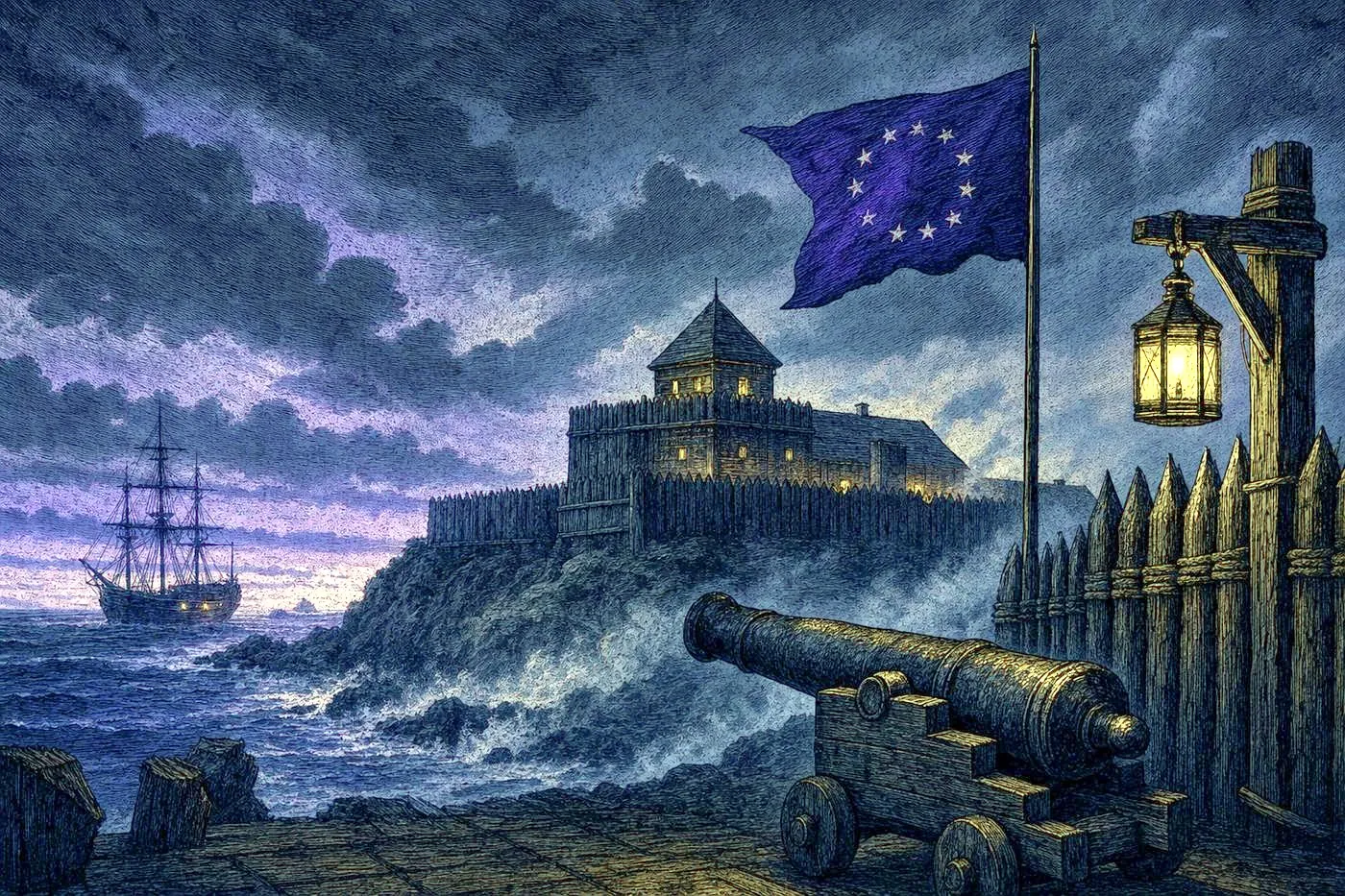
This North Carolina history timeline traces the state’s arc from the mysterious Lost Colony of Roanoke through colonial settlement, its leadership in the Revolutionary War, and transformation into a modern center of manufacturing and research. North Carolina’s history reflects centuries of Indigenous societies, English colonization, and economic adaptation.
Early Settlement and the Roanoke Colony Mystery
The coast of present-day North Carolina was originally inhabited by Indigenous Nations including the Cherokee, Catawba, Tuscarora, and Outer Banks peoples, who developed fishing and hunting cultures adapted to the Atlantic coast and inland regions. European exploration of North Carolina began with Spanish and English explorers in the 1500s. The most famous early attempt at English settlement was the Roanoke Island colony, sponsored by Sir Walter Raleigh in the 1580s. In 1585, colonists led by Ralph Lane established a settlement; after struggling with supply lines and conflict with Indigenous peoples, most returned to England in 1586. A second attempt began in 1587, led by John White, who brought settlers including women and children, the first English women and children to attempt settlement in North America. When White returned to England for supplies and came back in 1590, he found the colony abandoned. The word “CROATOAN” was carved into a post, but the fate of the colonists remains unknown, earning the settlement its enduring nickname: the “Lost Colony.” Theories about their fate range from death to assimilation with local Indigenous peoples, but the mystery has never been definitively solved.

Colonial Development and Revolutionary Leadership
After the mysterious end of Roanoke, permanent English settlement in North Carolina came later, following King Charles II’s 1663 charter granting the colony to eight Lords Proprietor. Settlements grew gradually along the coast and inland along rivers, including Bath (1706), New Bern, and Wilmington. Unlike Virginia’s plantation economy, North Carolina developed a more mixed economy with smaller farms, timber, naval stores, and small-scale trading. The colony gradually displaced Indigenous peoples through settlement, disease, and conflict. During the American Revolution, North Carolina played a distinctive early role: on April 12, 1776, at Halifax, the North Carolina Provincial Congress passed the Halifax Resolves, which authorized the state’s delegates to the Continental Congress to vote for independence, making North Carolina the first state to formally authorize independence, several months before the Declaration of Independence. The state was also a site of significant Revolutionary warfare, including the Battle of Guilford Courthouse (1781), a costly British victory that weakened British forces in the South. North Carolina ratified the U.S. Constitution on November 21, 1789, becoming the 12th state and joining the new federal union.
Industrial Development and Modern Economy
In the 19th century, North Carolina gradually developed textile manufacturing, particularly in the piedmont region, where water power drove mill development. By the early 20th century, textile manufacturing was dominant, with mill towns becoming major population centers. After World War II, North Carolina’s economy diversified. The state invested in higher education and research, and the Research Triangle Park, established in 1959 between Chapel Hill, Durham, and Raleigh, attracted technology, pharmaceutical, and research companies. This transformation from textile mills to research and technology created a more diversified, higher-wage economy. Today, North Carolina remains a center for textiles (though much reduced), but is also home to major pharmaceutical, technology, and financial services companies, making it one of the Southeast’s most economically dynamic states.