
This New Jersey history timeline chronicles the state’s evolution from Indigenous homelands through colonial rule, its pivotal role in the Revolutionary War, and development as a commercial and industrial power. New Jersey’s geography, wedged between the Delaware River and the Atlantic, made it strategically crucial to American independence.
Indigenous Peoples and Colonial Settlement
The region that became New Jersey was inhabited by the Lenape (also called Delaware), Munsee, and other Nations who lived along the coast and in the interior valleys. They developed sophisticated fishing, hunting, and agricultural practices adapted to the region’s rivers and forests, including seasonal harvests of shellfish, fish, and cultivated maize. The Lenape maintained complex trading networks with neighboring peoples and developed distinctive languages, cultural practices, and governance structures. Dutch traders arrived in the early 1600s and established fur-trading posts, including New Amsterdam (now New York City), with settlements spreading into New Jersey as the Dutch pursued profitable fur commerce. The Dutch period lasted until 1664, when English forces took control and renamed the colony New Jersey in honor of the Isle of Jersey in the English Channel. European colonization brought infectious diseases, displacement of Indigenous peoples, and disruption of traditional societies. The English proprietors faced ongoing disputes over governance and religious authority, and in 1676 the colony was divided into East Jersey and West Jersey, creating an administrative tangle that lasted until 1702, when the proprietorships were dissolved and New Jersey became a unified royal province under direct Crown control.
Revolutionary War and Constitutional Foundation
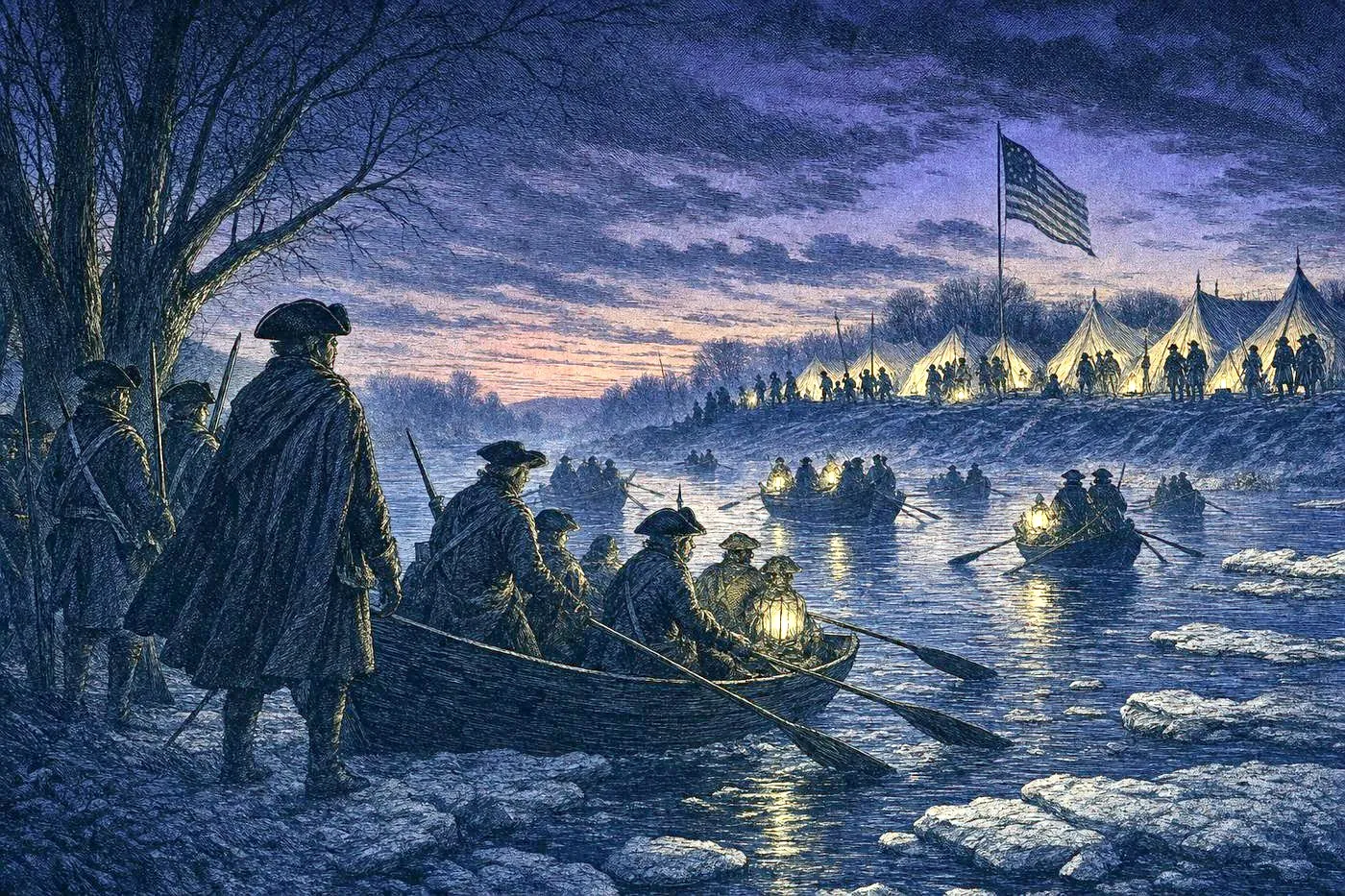
New Jersey’s Revolutionary history is inseparable from its geography. The state became a battleground between British and American forces, with New Jersey hosting some of the war’s most significant engagements. The British occupied much of northern New Jersey for extended periods, and both armies moved repeatedly across the state. The most celebrated action occurred on December 26, 1776, when General George Washington led his army across the frozen Delaware River and defeated Hessian troops at Trenton: a psychological and strategic victory that transformed American confidence at a low moment in the war, when the Revolutionary cause seemed nearly lost. Just weeks later, on January 3, 1777, Washington defeated British forces at Princeton, further establishing American military credibility and forcing British forces to reconsider their strategy in the North. These victories in New Jersey demonstrated that the Continental Army could defeat professional soldiers, boosted American morale, and helped turn the tide of the Revolutionary War. The state earned the nickname “Crossroads of the American Revolution” because of its strategic location and the frequency of military campaigns across its territory. Following independence, New Jersey became only the third state to ratify the U.S. Constitution on December 18, 1787, reflecting its early support for the new federal structure.
Industrial and Commercial Development
In the 19th and 20th centuries, New Jersey transformed into an industrial and commercial powerhouse. The state’s proximity to New York City, its natural harbors, and its network of rivers attracted manufacturers, railroads, and commerce. Cities like Newark, Jersey City, and Camden became industrial centers producing textiles, machinery, chemicals, and other goods. The state also became a crucial transportation hub, with railroads and highways connecting the Northeast. By the late 20th century, New Jersey developed as a major center for petrochemical refining, pharmaceutical manufacturing, and telecommunications. Today, despite its small geographic size, New Jersey ranks among the most densely populated states and maintains a diverse economy based on commerce, manufacturing, services, and proximity to major metropolitan areas.