
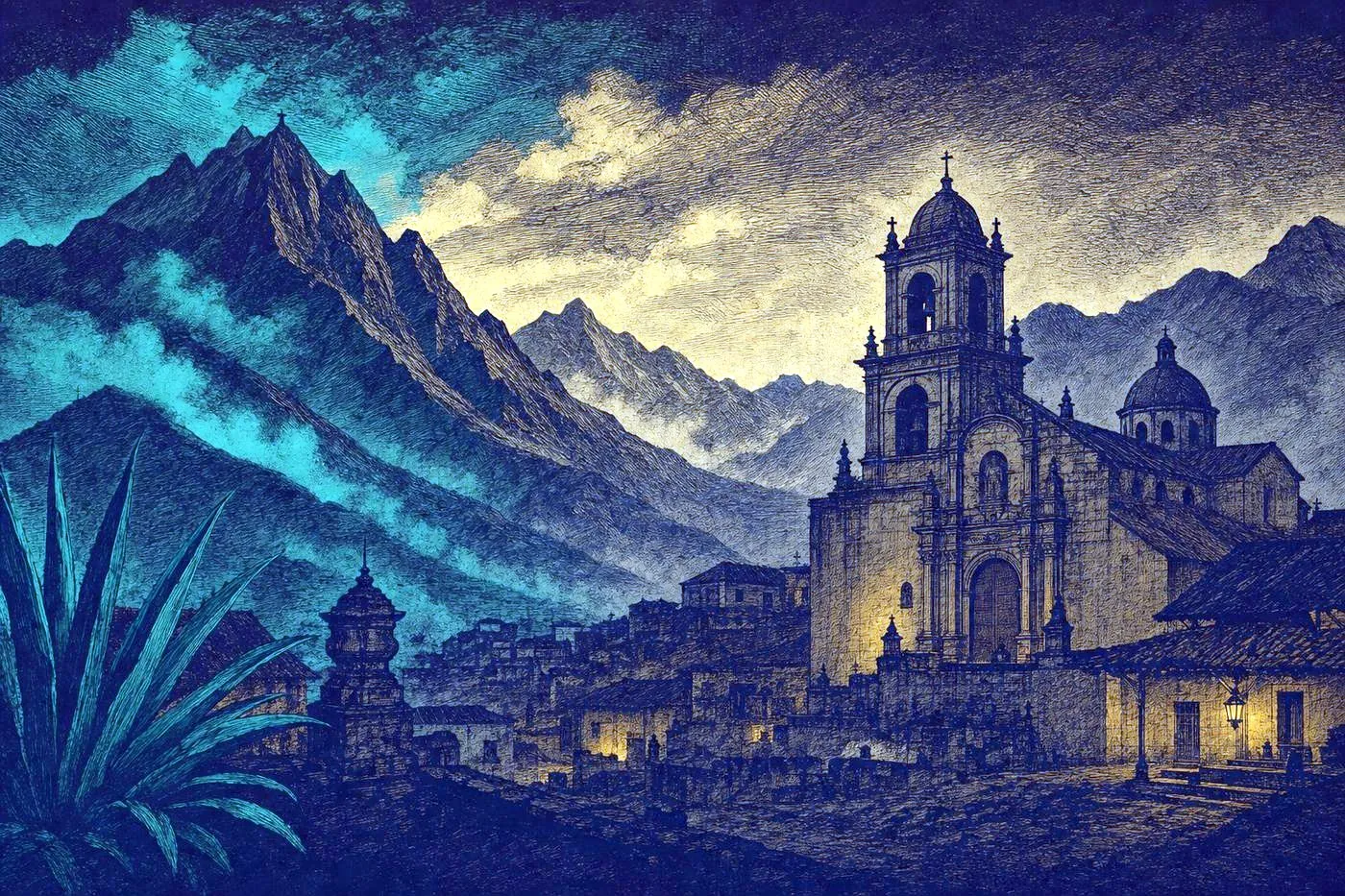
This Colombia history timeline traces the country from its indigenous societies through Spanish colonization to the independence movement led by Simón Bolívar.
Indigenous Societies and Spanish Colonization
Long before European contact, the highlands of present-day Colombia were home to the Muisca confederation, an agricultural and trading society known for its sophisticated goldwork, while the Tairona people developed complex settlements along the Caribbean coast and in the Sierra Nevada de Santa Marta. Spanish exploration of the Colombian coastline began around 1499–1500 with voyages associated with Rodrigo de Bastidas, and in 1525 Bastidas founded Santa Marta, generally regarded as the first permanent Spanish settlement in the region. Spanish expansion into the interior followed over the next decade, culminating in 1538 when Gonzalo Jiménez de Quesada founded Santa Fe de Bogotá after a difficult campaign that subdued the Muisca and brought their territory under Spanish control. Quesada’s expedition arrived in the highlands at roughly the same time as two other Spanish parties approaching from different directions, a coincidence that led to a period of rivalry among the conquistadors over jurisdiction before Spanish royal authority formally settled the matter.
Colonial Administration and the Viceroyalty of New Granada
Spain gradually formalized its control over the region, and in 1717 (reorganized again in 1739) it established the Viceroyalty of New Granada, an administrative unit governed from Bogotá that encompassed much of present-day Colombia, Venezuela, Ecuador, and Panama. For roughly two and a half centuries, Spanish colonial rule shaped the region’s institutions, economy, and social structure, built substantially on extraction of resources including gold, and organized around a rigid colonial hierarchy that placed indigenous and enslaved African populations at its base. Colonial society was organized around a rigid racial and social hierarchy, with Spanish-born officials and American-born Spaniards (criollos) occupying the top tiers above indigenous peoples, enslaved Africans, and increasingly numerous mixed-heritage populations. By the early nineteenth century, Enlightenment ideas circulating among the educated criollo class, together with the disruption caused by Napoleon’s invasion of Spain in 1808, fed growing calls for self-government, echoing similar movements breaking out across Spanish America.
Independence and the Legacy of Simón Bolívar
Cartagena declared self-rule in 1810, part of a wider wave of juntas that broke out across Spanish America that year, though full independence was neither immediate nor secure. The decisive turn came under Simón Bolívar, whose forces won a crucial victory at the Battle of Boyacá on August 7, 1819, effectively securing independence for New Granada and clearing the way for the formation of Gran Colombia, a short-lived union that also included present-day Venezuela, Ecuador, and Panama. Internal political and regional tensions proved difficult to sustain, however, and Gran Colombia dissolved in 1830, the year of Bolívar’s death, leaving New Granada to continue as a separate republic under a succession of names before adopting the name Colombia later in the nineteenth century. That century brought further upheaval, including repeated civil wars between emerging Liberal and Conservative factions and the loss of Panama, which separated in 1903 with U.S. backing to enable construction of the Panama Canal. Bolívar’s role in the independence period nonetheless remains central to Colombian and broader Latin American national identity, commemorated in place names, monuments, and public holidays across the region to this day.