
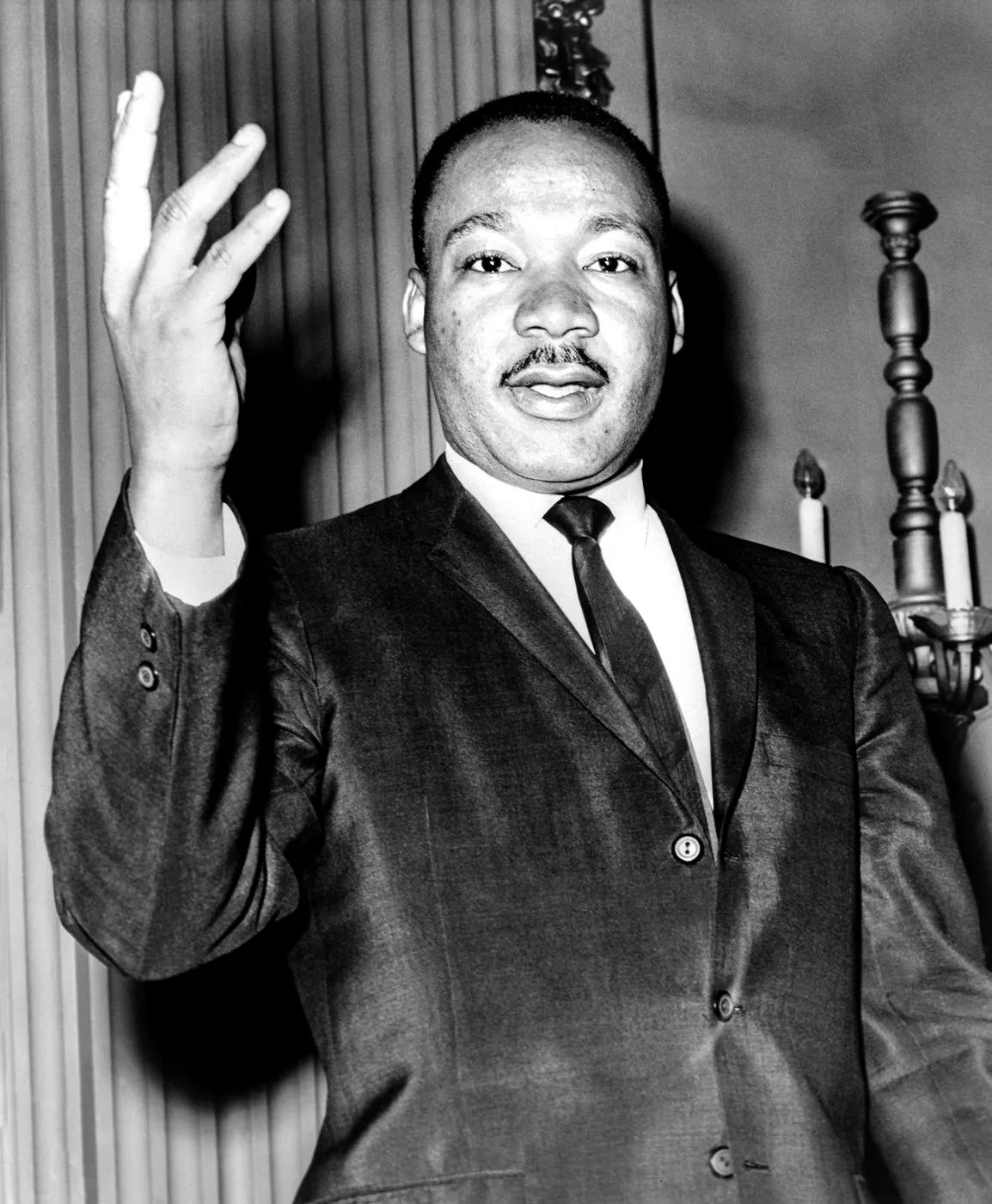
Early Life and the Path to Ministry
Martin Luther King Jr. was born Michael King Jr. on January 15, 1929, in Atlanta, Georgia, the son of a Baptist pastor. His father later changed both his own name and his son’s to Martin Luther, after the Protestant reformer, following a trip to Germany. King grew up in a household steeped in the Black church tradition of the American South, and he went on to study at Morehouse College, the historically Black men’s college in Atlanta, before pursuing further theological training at Crozer Theological Seminary in Pennsylvania. He completed a doctorate in systematic theology at Boston University in 1955. It was in Boston that he met Coretta Scott, a music student, and the two married in 1953. In 1954, King accepted the pastorate of Dexter Avenue Baptist Church in Montgomery, Alabama, a posting that placed him, almost by circumstance, at the center of the event that would launch his public career.
Montgomery to the March on Washington
That event arrived in December 1955, when Rosa Parks was arrested in Montgomery for refusing to give up her bus seat to a white passenger. Montgomery’s Black community responded with a boycott of the city’s bus system, and the 26-year-old King, new to the city and not yet closely tied to existing factions, was elected to lead the newly formed Montgomery Improvement Association. The boycott held for roughly a year, ending only after a Supreme Court ruling struck down bus segregation in Montgomery, and it established King, still in his twenties, as a national figure. In 1957 he helped found the Southern Christian Leadership Conference (SCLC), an organization of Black churches and ministers built to coordinate nonviolent protest across the South, and served as its first president for the rest of his life.
The years that followed brought a string of campaigns: against segregated lunch counters, against discriminatory hiring, against segregation in Birmingham, Alabama, where King was jailed in the spring of 1963 and wrote his widely read “Letter from Birmingham Jail” in defense of nonviolent civil disobedience. That same year, on August 28, 1963, King addressed a crowd of roughly 250,000 people gathered at the Lincoln Memorial for the March on Washington for Jobs and Freedom. His speech that day, culminating in the refrain “I have a dream,” became the single most recognizable moment of the American civil rights movement and helped build momentum for federal civil rights legislation.

Selma, the Nobel Prize, and Memphis
President Lyndon Johnson signed the Civil Rights Act into law in July 1964, outlawing segregation in public accommodations and employment discrimination on the basis of race. Later that year, King was awarded the Nobel Peace Prize in recognition of his leadership of the nonviolent struggle for civil rights, becoming, at the time, one of the youngest recipients of the honor. In early 1965, King and the SCLC turned their attention to voting rights, organizing marches from Selma to Montgomery, Alabama, in the face of violent resistance from local law enforcement; the campaign contributed directly to Congress passing the Voting Rights Act of 1965 later that year.
In his final years, King broadened his focus to economic inequality and, controversially among some allies, to public opposition to the Vietnam War. On April 4, 1968, he was assassinated on the balcony of the Lorraine Motel in Memphis, Tennessee, where he had traveled to support a strike by the city’s sanitation workers. His death set off unrest in cities across the country and cemented his standing as the central figure of the American civil rights movement, commemorated today by a federal holiday and a national memorial in Washington, D.C.