
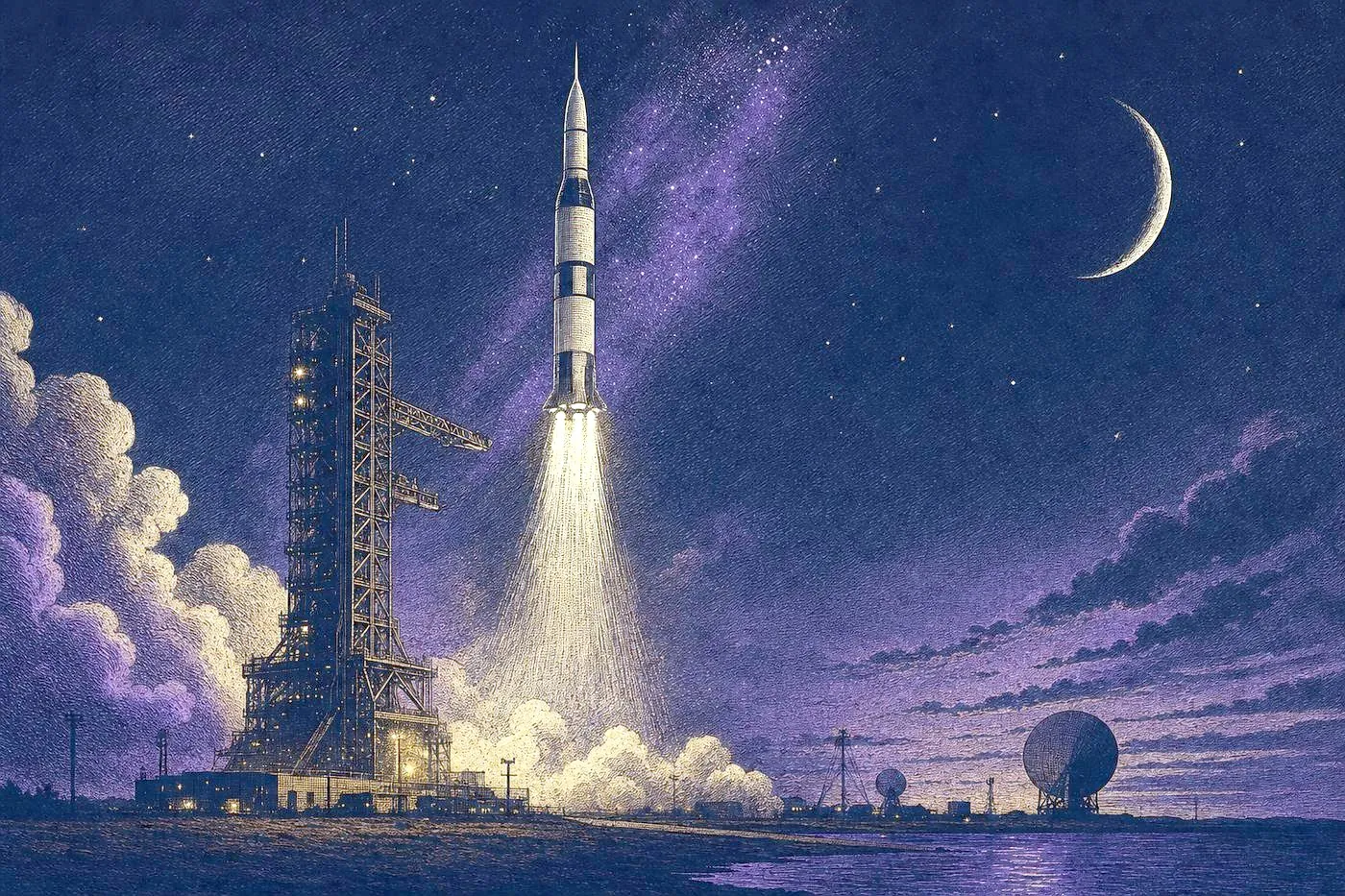
This space race timeline of events traces the Cold War contest between the United States and the Soviet Union, moving from the first satellite in orbit to the Moon landing that settled the argument over who led in space, and toward the cooperation that eventually closed this chapter of space history.
Space Race Timeline: Sputnik and the Race to Orbit
The rivalry begins in earnest on October 4, 1957, when the Soviet Union launched Sputnik 1, the first artificial satellite to orbit the Earth. The small, beeping sphere caught the American public and government off guard, stoking fears that Soviet rocket technology, and by extension its missile capability, had outpaced the West’s. The United States responded within a year, establishing the National Aeronautics and Space Administration (NASA) in 1958 to coordinate a civilian space program and compete directly with Soviet achievements, a decision that shaped the rest of twentieth-century space history.
The Soviet Union extended its early lead in April 1961, when cosmonaut Yuri Gagarin became the first human to orbit the Earth, completing a single orbit aboard Vostok 1 before returning safely. The achievement deepened American anxiety about falling behind, and weeks later President John F. Kennedy asked Congress to commit the country to landing an astronaut on the Moon before the decade was out, a goal with no guarantee of success but one that reframed the cold war space race timeline around a single, highly visible target.
The Moon Landing That Decided the Space Race
Both programs pushed rapidly through the 1960s, each notching firsts meant to demonstrate progress toward the Moon. In March 1965, Soviet cosmonaut Alexei Leonov performed the first spacewalk, spending several minutes outside his spacecraft in open space. NASA’s Apollo program suffered a serious setback in 1967, when a cabin fire during a launch-pad test killed three astronauts, but the program recovered and accelerated toward its Moon-bound goal.

The competition reached its defining moment on July 20, 1969, when Apollo 11 astronauts Neil Armstrong and Buzz Aldrin became the first humans to walk on the Moon, while Michael Collins orbited above in the command module. An estimated global television audience of hundreds of millions watched the Moon landing, and the achievement effectively answered Kennedy’s challenge, even as the Soviet Union continued crewed missions of its own.
From Rivalry to Cooperation: The Cold War Space History Legacy
After Apollo 11, American enthusiasm for further Moon landings gradually cooled, and both countries increasingly shifted attention toward space stations and longer-duration missions: the Soviet Union with its Salyut program and the United States with Skylab. The clearest symbolic end to the space race timeline of events came in July 1975, when an American Apollo spacecraft and a Soviet Soyuz spacecraft docked in orbit as part of the Apollo-Soyuz Test Project, the first joint crewed mission between the two nations. The handshake exchanged by the astronauts and cosmonauts in orbit stood in deliberate contrast to the competitive tone of the previous two decades, and this cooperative turn remains a defining moment in the wider history of spaceflight.
Frequently Asked Questions
What was the Space Race?
It was the Cold War-era competition between the United States and the Soviet Union to achieve milestones in spaceflight. The cold war space race timeline runs roughly from the 1957 launch of Sputnik 1 to the joint Apollo-Soyuz mission of 1975.
Who won the Space Race?
There is no single agreed answer. The Soviet Union achieved several earlier firsts, including the first satellite and first human in orbit, while the United States achieved the first crewed Moon landing in 1969, an outcome many regard as the race's culminating goal.
What ended the Space Race?
The 1975 Apollo-Soyuz Test Project, in which an American and a Soviet spacecraft docked in orbit, is generally treated as the symbolic close of the rivalry, though both countries' space programs continued well beyond that point.
Why did Kennedy commit to a Moon landing?
Following Yuri Gagarin's 1961 orbital flight, Kennedy sought a bold, achievable goal that could reassert American leadership in space and rally support behind a sustained national effort to reach the Moon.